
Chattanooga, TN · Garage Door Service
Cable Repair for Soddy-Daisy's 1980s-Era Garage Doors
Soddy-Daisy's houses mostly date to the mid-1980s, meaning wider steel doors on standard torsion cable. Here's what that means for a snapped or frayed cable.
- Repairs & new doors
- Springs & openers
- Serving 8 nearby communities
Time on the Job
We run this job from Chattanooga, about 14 miles south of Soddy-Daisy, so a cable call out here isn't a different crew or a different truck than the one working the city side of the service area. It just means we fold the drive into the schedule. We don't keep a branch or a drop box in Soddy-Daisy, and we won't pretend otherwise - what we can tell you is that a broken lifting cable on a door this size doesn't wait well, so we try to slot these calls in close to when you reach out rather than stacking them at the end of a route. Because the typical house here was built around 1985, a decade or more past the older stock closer to the city core, the doors we're replacing cable on tend to be wider single-piece or sectional steel doors on standard torsion hardware, not the narrow single-car doors you'd find on an older lot. That changes the cable gauge and the drum setup we bring on the truck.
What You Are Seeing
A cable failure on a door built to the 1980s standard usually shows up one of two ways. Either the door drops crooked - one side rides down while the other hangs up, because one cable let go while the other is still wound on its drum - or the door won't move at all because a frayed strand jumped the drum and jammed. On the wider 16-foot doors common in Soddy-Daisy's era of construction, that crooked hang puts real strain on the tracks fast, because there's more door for the remaining cable to carry. You might hear a bang when it goes, or just find the door stuck halfway with visible kinks or rust bloom on the exposed wire. Either way, the door is under spring tension even when the cable is broken, and that's the part that makes this a bad one to leave sitting.
Doing It Yourself
We'll say this plainly: don't open the door and don't pull the cable off the drum yourself. A garage door cable works against a loaded torsion or extension spring, and a cable that's already frayed can let go the rest of the way while you're standing under the door. We're not going to pretend there's a safe shortcut here to save a service call. What a homeowner can do safely is leave the opener unplugged, keep the car and anyone's hands away from the door, and take a photo of the drum and the broken strand if you can see it from a few feet back - that tells us what we're bringing before we're on site. If the door is a two-car width common to the 1980s houses out this way, the cable and drum sizing is usually standard enough that we carry it on the truck without a special order.
How We Fix It
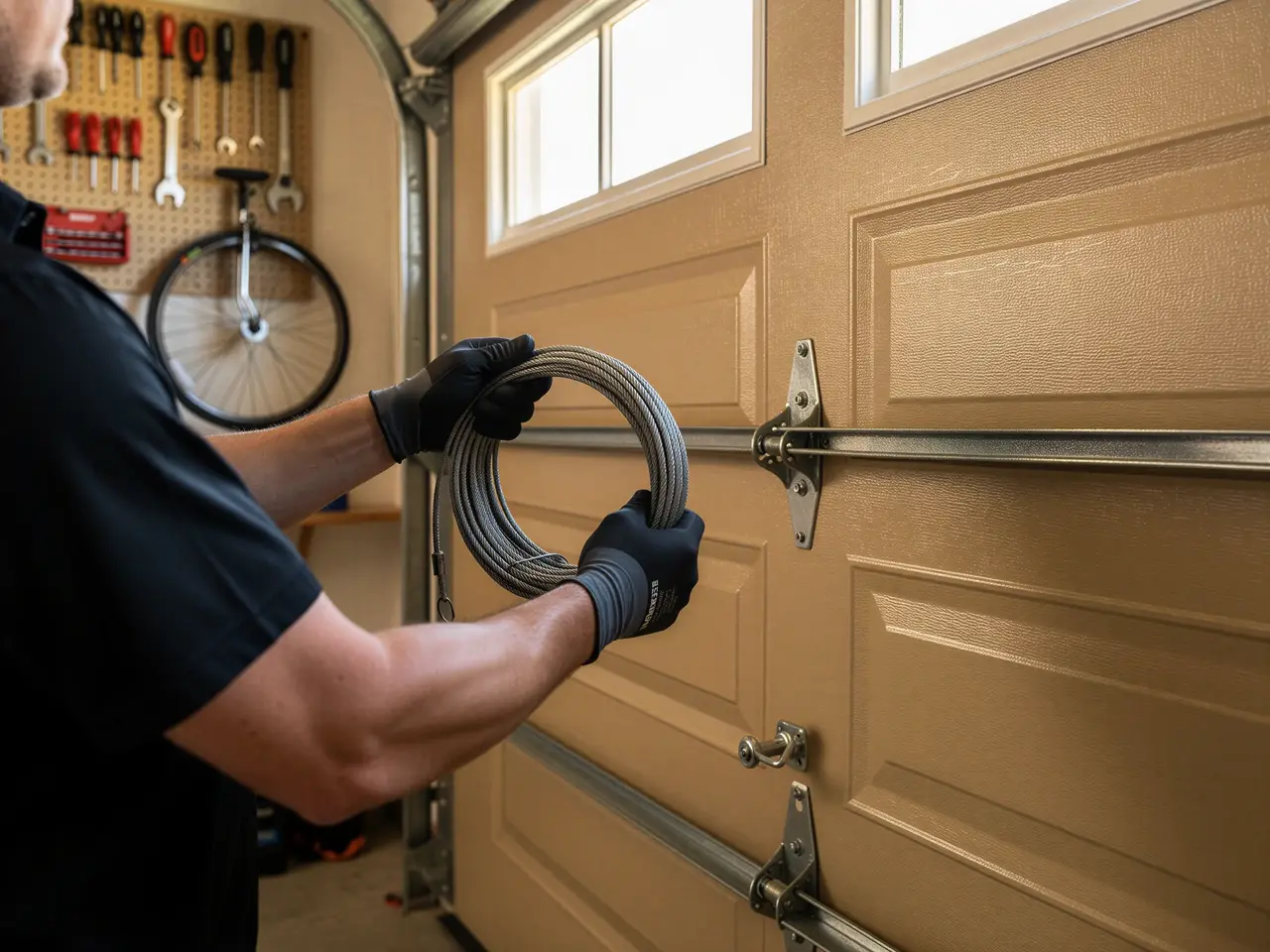
We release the spring tension first, always, before touching a cable - that's the step that actually matters for safety, more than any tool. Then we pull both cables, not just the broken one, because a cable that's forty years old on one side is close behind on the other, and running a new cable against an old one just means a second call later. We check the drum for grooving where the old cable wore in, since a door this width puts steady load on that groove, and swap the drum if it's cut deep enough to let a new cable walk. Once the new cable is set and tensioned evenly on both sides, we run the door a few cycles and check it tracks straight before we call the job done. Parts for a standard-width residential cable and drum are usually in stock on the truck; anything outside standard sizing may mean a short wait on a part.
What Causes It Around Here
This area sits in a moderate-cold climate band, with real temperature swings between winter and summer that work steel cable harder than a steady climate would - the wire flexes with every expansion and contraction cycle, and that's what eventually frays a strand at the drum. Combine that with the age of the hardware: a house built around 1985 is now closing in on forty years old, and the original galvanized cable on a door that's never been touched is well past the point where it's still reliable. We also see a fair number of Soddy-Daisy owners asking for galvanized replacement cable instead of cheaper aluminized wire, which lines up with household income here running close to $67,824, a touch above the wider area's $66,814 - it's a small upgrade cost that pays off in a door that isn't back on our schedule in five years.
Frequently asked questions
How old does a cable usually get before it fails?
On a door built to the mid-1980s standard, original galvanized cable often runs close to its full working life before it frays, especially with the freeze-thaw cycling this area gets. If your house dates to around that era and the cable has never been replaced, a frayed strand is more a matter of when than if.
Can I drive to Soddy-Daisy for a same-day cable fix?
We cover Soddy-Daisy from Chattanooga, about 14 miles out, and we don't keep a local branch here. We schedule based on what's on the route that day rather than promising a fixed response window, so the honest answer is call and we'll tell you where you land.
Is it cheaper to just replace the one broken cable?
We don't recommend it. Cables are sold and age in pairs, and replacing only the broken side on a door this wide leaves the older cable on the other drum close behind it. We replace both sides on a cable call so you're not paying for a second truck trip in a year or two.
More garage door services in Soddy Daisy
Book garage door service in Chattanooga
Call now or request a quote - tell us what the door is doing and where you are.