
Chattanooga, TN · Garage Door Service
Garage Door Service for Chattanooga's Older Housing Stock
Chattanooga's 1960s-70s housing stock and cold winters wear out torsion springs fast. We service doors from East Chattanooga to Lookout Valley and everywhere between.
- Repairs & new doors
- Springs & openers
- Serving 8 nearby communities
What Causes It Around Here
Most of the houses we work on across Chattanooga went up between 1963 and 2004, with the median landing around 1979, and the bulk of the stock in the 14 neighborhoods we cover - East Chattanooga, Glenwood, Stuart Heights, Northshore, Hixson, and the rest - dates to the 1960s and 70s. That matters because torsion springs are rated for a fixed number of open-close cycles, and a door installed when a house was built in that window is now decades into a part that was never meant to last forever.
Add the climate. Chattanooga sits in a cold-moderate band, and that means real winter swings - steel springs contract in cold air, grease and lubricant on the coils thicken up, and the metal gets more brittle right when the door is working hardest to lift against a heavier load. A spring that's been cycling since the Carter administration doesn't need much of a push in January to finally let go.
This isn't a problem unique to one street. It shows up block after block in the older sections because the houses, the hardware, and the weather all aged together. Newer builds in the service area don't see it nearly as often - it's the 60s and 70s stock that carries the risk.
What You Are Seeing
The most common call we get is a door that stops halfway, or one that won't budge at all and the opener just hums or grinds. Sometimes it's a loud bang from the garage - that's usually the spring itself letting go, not the opener. You might notice the door feels unusually heavy if you try to lift it by hand, or it slams down the last foot instead of settling.
A few homeowners describe the door as 'working fine yesterday' - torsion springs don't wear gradually in a way you can see. They hold tension until they don't, and cold mornings are when that last bit of fatigue tends to show up. If your opener is straining, clicking, or reversing on its own partway through a cycle, that's often the same root cause: the spring isn't doing its share of the lift anymore, so the motor is trying to do it all.
What You Pay
We're not going to put a number here that isn't honest. Spring replacement cost depends on the door's weight, whether it's one spring or two, and what size and wind the spring needs to match your specific door - that's not something we can quote blind over the phone or in a web page. What we can tell you is that a proper job means matching the spring to the door, not grabbing whatever's on the truck and hoping it's close.
One honest limitation: if your opener and springs are both original to a house built in that 1960s-70s window, repairing just the spring sometimes isn't the better move - the opener may be close behind it. We'll tell you straight if replacement makes more sense than patching one part at a time, rather than running up a bill on a door that's going to need the next part fixed in a year.
How We Fix It
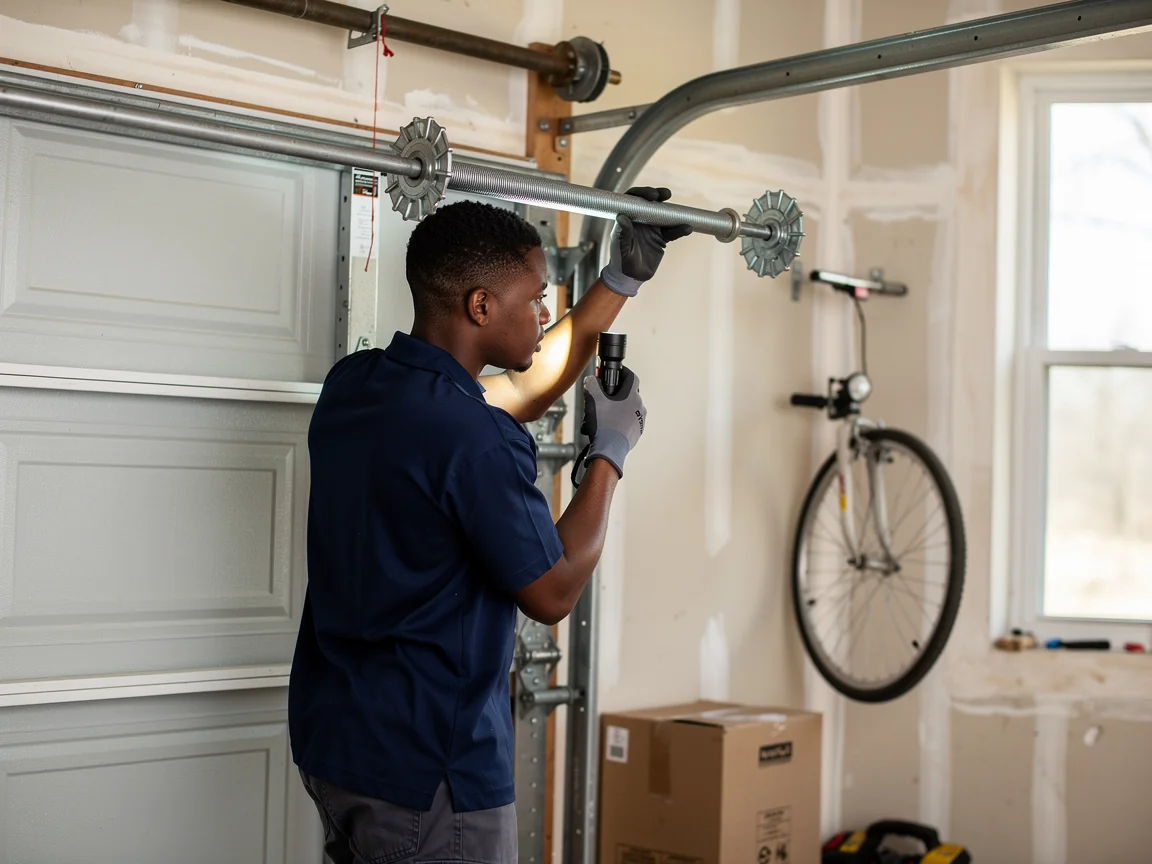
We come out, check the door's actual weight and balance, and measure for the right spring - wire size, wind direction, and length all have to match the door, not just the opening. Guessing on torsion spring size is how doors end up unbalanced, which wears out openers faster and puts strain back on the cables and rollers.
Given the cold-moderate climate here, we also check that the hardware is lubricated for winter cycling, not just installed and left. A spring that's correctly sized but poorly maintained in cold weather will still fail early. We test the door through a full range of motion before we leave, and we check the opener's force settings so it isn't compensating for a spring that's now doing its job correctly.
We work across the Chattanooga service area, including the closer-in spots like Red Bank, East Ridge, and Signal Mountain, out to farther towns like Soddy-Daisy and Whitwell. If you're not sure your address is covered, give us a call.
Frequently asked questions
Why did my garage door spring break in the winter and not in summer?
Cold weather makes steel springs more brittle and causes lubricant on the coils to thicken, which adds resistance right when the spring is already near the end of its cycle life. In Chattanooga's cold-moderate climate, that combination is often what pushes an aging spring from worn to broken.
My house was built in the 1970s - is my garage door original?
It's common. A lot of Chattanooga's housing stock dates to the 1960s and 70s, and plenty of those doors and openers are still running on original or early-replacement hardware. If yours hasn't been serviced, the spring is likely well past its rated cycle count.
Can you tell me a price over the phone?
Not accurately. Spring replacement cost depends on your door's weight and the specific spring size and wind it needs, which we have to measure in person. We'll give you a real number once we've looked at the door, not a guess based on a phone call.
Do you service areas outside Chattanooga proper?
Yes. We cover the surrounding area including Red Bank, East Ridge, Harrison, Signal Mountain, Walden, and farther towns like Soddy-Daisy and Whitwell. Call to check your specific address.
By Neighborhood
Garage Door Service across the Chattanooga area
We also handle garage door service in these Chattanooga-area suburbs.
Book garage door service in Chattanooga
Call now or request a quote - tell us what the door is doing and where you are.