
Chattanooga, TN · Garage Door Service
Panel Replacement for East Ridge's 1960s Garage Doors
East Ridge's houses mostly went up around 1965. We replace cracked, dented, and rusted panels on that era's doors, matched to width and gauge, from our Chattanooga shop.
- Repairs & new doors
- Springs & openers
- Serving 8 nearby communities
Time on the Job
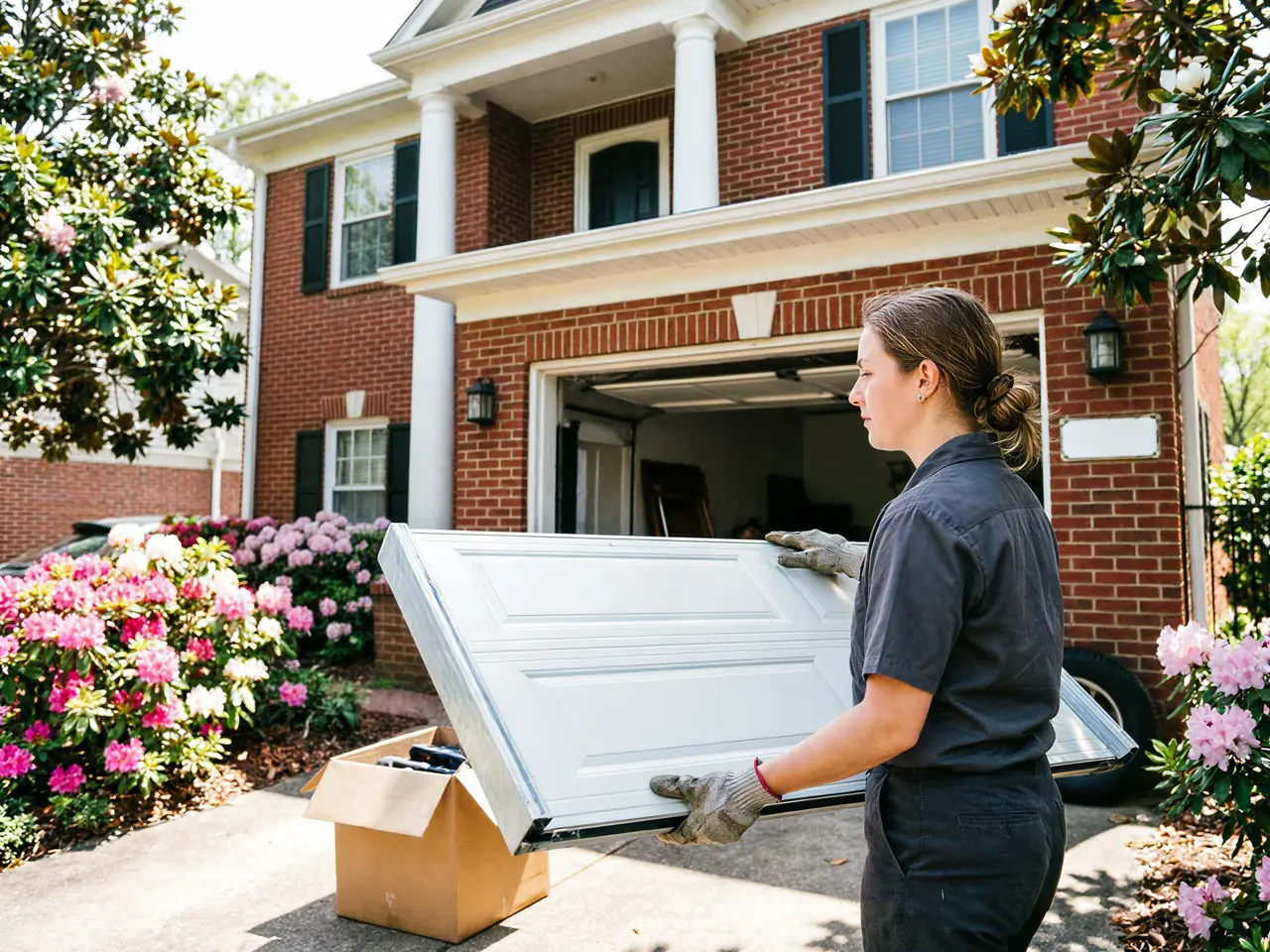
Most of East Ridge went up around 1965, a decade before the broader Chattanooga service area's median build year of 1979. That gap matters on a panel job. Houses from this stretch typically carry narrower garage openings than what builders started framing in the late '70s and '80s, and the doors that went in at construction were often steel or wood sections on a basic raised-panel pattern, hung on torsion or extension hardware that's changed little in profile even if the metal gauge has gotten thinner since. When we pull up to measure a damaged section here, we're usually looking at a door that's either original or a straight like-for-like replacement from a remodel decades back, not one of the newer insulated models with a composite skin. That changes what we order and how the new panel gets trimmed to fit the existing track and hinge spacing. A panel swap on a house like this usually runs faster than on newer stock, mostly because there's less to match - fewer color options, simpler hardware, no window inserts to source separately unless the house had them from the start.
Doing It Yourself
A single dented or cracked panel on a 1960s-era door is one of the few garage door repairs a reasonably handy homeowner can attempt, provided the section is a standalone bolt-on piece and not part of a one-piece slab door, which some houses from this build era still have. One-piece doors don't take panel swaps - the whole door comes out as one unit on a track system that's different from sectional doors, and there's no partial fix. If you've got a sectional door with hinges between each panel, you can usually unbolt the damaged section after releasing spring tension, but that tension release is the part that hurts people. Extension springs stretched across old track brackets have let go on us more than once when a homeowner had already loosened the wrong bolt. If the door is more than one panel wide and the track geometry has shifted even slightly from the dent, get it looked at before pulling anything apart.
Getting It Booked In
We run out of Chattanooga and cover East Ridge from about 5 miles out, so there's no walk-in counter here - a job gets scheduled, we bring the panel stock and hardware with us, and we measure the opening before cutting anything to final size. Because a lot of East Ridge's doors are older and narrower than newer construction elsewhere in the service area, we try to confirm the exact width and panel height over the phone first, since standard big-box panel sizes don't always match what's on a house built when the opening codes were different. That one extra question up front saves a second trip more often than not.
Where This Job Goes Sideways
The panel itself is rarely the hard part - it's what's attached to it. On a house from the mid-1960s, the hinges and rollers holding that panel have usually never been swapped, and they're often rusted into the track or stripped at the screw holes from forty-plus years of expansion and contraction. Cold-weather swings - and this area sits in a moderate cold climate band with real seasonal temperature shifts - work steel fasteners loose over time, so pulling one bad panel sometimes reveals that the hinge on either side needs replacing too, not just reusing. We also run into mismatched panel colors on houses that already had one section replaced years back by someone else with an off-the-shelf part; matching an exact finish on an old door isn't always possible, and we tell people that up front rather than promise a seamless blend. If the door's track is bent from whatever hit the panel, that's a separate repair, and sometimes it's cheaper to replace the whole door than chase parts for something this old section by section.
Parts We Carry
We stock steel sections in the common widths that match East Ridge's housing era - mostly 1965-vintage openings - along with standard hinges, rollers, and end stiles sized for sectional doors from that period. What we don't keep on the truck is a deep inventory of wood panel replacements or discontinued window-insert styles; those sometimes take a special order, and we'll tell you that cost and lead time before you commit rather than after. For insulated panels on any newer sectional doors in the area, we carry standard gauge options, but we're not trying to match a 1965 door to a 2020s panel line - if the whole door's hardware has aged out, replacement usually makes more sense than a patch.
What Causes It Around Here
Dented panels around East Ridge come from the ordinary stuff - a car bumper misjudged in a narrower driveway, a trash can clipped in reverse, a basketball backboard mounted too close. But the age of the housing stock plays a real role too: a 43,198-household service area with a median build year of 1979 overall still has pockets, East Ridge among them, sitting closer to 1965, and panels that old have thinner steel than what ships today. Thin steel dents easier and holds the dent's shape, where a newer panel might flex back. Combined with a median household income here of $55,988 - lower than the broader area's $66,814 - we see more owners asking for a single-panel fix instead of a full door swap, which is a reasonable call as long as the rest of the door's hardware still has life in it.
Frequently asked questions
Can you match the panel color on my East Ridge garage door exactly?
Not always. If your door is original to a mid-1960s house, the factory finish may no longer be made, and sun fading over decades changes the shade anyway. We'll bring the closest current match and show it to you before installing, but an exact blend on an older door isn't something we can promise.
Is it cheaper to replace one panel or the whole door?
Depends on the door's age and hardware condition. On a door from East Ridge's typical 1965 build era, if the hinges and rollers near the damage are also worn, a single panel swap plus hardware can approach the cost of a full door. We'll check both before quoting.
Do you have a branch in East Ridge?
No. We run out of Chattanooga, about 5 miles from East Ridge, and bring panel stock and tools with us on the scheduled job rather than from a local counter.
Why does my 1960s door dent so easily compared to newer ones?
Steel gauges have thickened over the decades for most residential doors. A panel from the 1965 era is typically thinner steel than what ships today, so it dents more readily and tends to hold the dent rather than flex back out.
More garage door services in East Ridge
Book garage door service in Chattanooga
Call now or request a quote - tell us what the door is doing and where you are.