
Chattanooga, TN · Garage Door Service
Garage Door Maintenance for East Ridge's 1960s Housing Stock
East Ridge homes cluster around a 1965 build year, which means original torsion springs and hinges on most doors. Here's what that means for upkeep and when to call.
- Repairs & new doors
- Springs & openers
- Serving 8 nearby communities
Time on the Job
Most of East Ridge went up around 1965, and that single fact tells us more about your door than almost anything else. A house built that year has had sixty years to accumulate rust, stretched cable, and hinges that have never once seen grease. Across the wider service area the housing stock runs 1963 to 2004 with a median of 1979, but East Ridge sits right at the early edge of that range - older than most of the territory we cover. That matters because a door from the mid-60s was built to a different hardware standard than anything installed in the 80s or later. If nobody's touched the springs, rollers, or hinges on your door since it went up, you're not maintaining original equipment anymore - you're keeping a sixty-year-old machine running on borrowed time. We service roughly 9,578 households in East Ridge, and a good share of those doors are carrying parts that predate galvanized cable and sealed bearings. That's not a knock on the neighborhood - it's just what happens when a door never gets looked at. Maintenance on a house this age isn't about tuning something new. It's about finding what's about to fail before it does, on hardware that's long past any factory spec.
Doing It Yourself
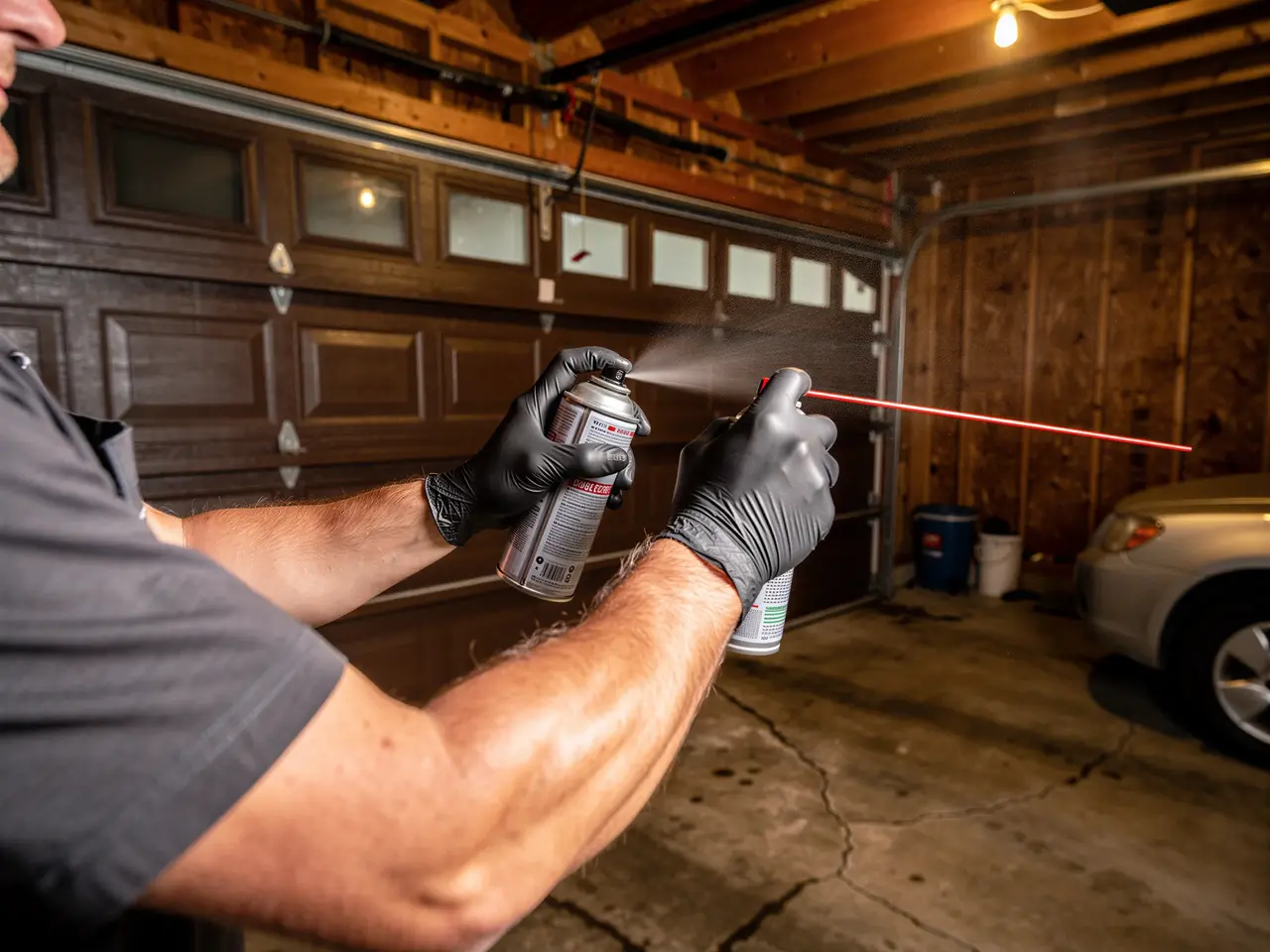
There's real maintenance a homeowner can do without a truck showing up. Wipe down the tracks and check for dents or debris. Listen for grinding when the door runs - that's usually a roller going bad, and it's cheap to replace before it takes a track with it. Lubricate hinges and rollers with a garage-door-specific lubricant, not WD-40, which washes out grease rather than adding it. Check the balance: disconnect the opener, lift the door halfway by hand, and let go. It should hold. If it drops or shoots up, the springs are out of balance and that's not a DIY fix. What you should not touch is the torsion spring itself. On a door this old, the spring has likely never been replaced, and a spring under tension that lets go can break bones or worse. Leave that one alone. Given that East Ridge's median household income runs $55,988 - below the $66,814 figure for the broader area - we get it that folks want to stretch a repair bill as far as it'll go. The lube-and-look-over routine costs nothing and catches a lot. The spring job is the one place that's worth paying for.
Getting It Booked In
We run out of Chattanooga, about 5 miles from East Ridge, so there's no local branch to call - a crew comes out from the shop for every job here, same as the rest of the territory. What's worth knowing going in: tell us the age of the house if you know it. On a door built around 1965, we're not guessing about what we'll find once the panel comes off - we're expecting original torsion hardware and planning the visit around that. That saves a second trip. If you've got the opener's model plate handy or know roughly when the door was last serviced (if ever), that helps too. We don't carry every part for every job on the truck by default, so a rough idea of what we're walking into - original spring, worn weatherstripping, an opener from decades back - lets us bring the right stock the first time instead of coming back.
Where This Job Goes Sideways
The common mistake on a house this age is treating a noisy door as a lubrication problem when it's actually a worn spring near the end of its life. A spring is rated for a number of open-close cycles, not years, but on a door installed around 1965 it's had decades to rack those cycles up regardless. When a spring that old finally lets go, it tends to go all at once, and often it takes a cable or a pulley with it. The other place this goes wrong: people patch a failing opener motor instead of replacing it, because the door still opens, just slower and louder every month. On original 1960s hardware, that's usually the bearing plates wearing out, and no amount of oil fixes a bearing plate that's worn oval. Here's the honest limit - if the drum, torsion tube, and springs are all original and all showing wear at once, piecemeal repair stops making sense. At that point you're paying labor three separate times for a problem that's really one job: replace the whole spring-and-hardware assembly together, not one part at a time as each one fails.
Parts We Carry
On the truck for a typical East Ridge call: torsion springs sized for standard single and double doors, galvanized lift cable, steel rollers (sealed-bearing, since the old open-bearing style on original doors is what's usually worn), hinges, and center and end bearing plates. We also stock weatherstripping and bottom seal, since rubber from the 60s and 70s has usually hardened and cracked by now regardless of how well the rest of the door held up. What we don't carry as a standard stock item is a wood panel replacement cut to match an original door style from that era - those panels were often custom to the builder, and if a panel's rotted or split, we're looking at sourcing or full-door replacement rather than a patch. That's a limitation worth knowing up front rather than after a truck's already made the trip.
What Causes It Around Here
The climate here runs cold-moderate, which doesn't bring the brutal freeze-thaw cycling of a true northern winter but still puts condensation and seasonal temperature swings on metal parts year-round. On a door with original 1965 hardware, that slow cycle of expansion and contraction is what eventually fatigues a spring that's gone unreplaced for decades - it's not one bad winter, it's sixty of them. Combine that with hinges and rollers that have likely never been lubricated, and you get the pattern we see most in this part of the service area: gradual stiffening, then a sudden failure rather than a slow warning. It's a different fault pattern than you'd find in a house built in the 90s, where the hardware is newer and the failures tend to be more about opener electronics than mechanical fatigue.
Frequently asked questions
How old is the hardware on a typical East Ridge garage door?
If the house was built around the neighborhood's 1965 median and nobody's swapped the door, the torsion spring, cable, and hinges are likely original. That's sixty years of cycles on hardware that was never designed to last that long without replacement.
Can I replace a torsion spring myself?
No. A torsion spring holds enough stored tension to cause serious injury if it releases while you're working on it, especially on an older door where the hardware may be rusted or already stressed. This is one job to leave to someone with the right bars and clamps.
Do you have a branch in East Ridge?
No, we work out of Chattanooga, about 5 miles away, and send a truck out for every East Ridge job. There's no local depot, so give us a call ahead rather than expecting a drop-in visit.
What part usually fails first on a house this age?
On original 1960s hardware it's usually the torsion spring or the roller bearings, since both wear out through use rather than age alone. A door that's gotten louder or slower over the years, rather than failing suddenly, is often telling you one of those two is close to done.
More garage door services in East Ridge
Book garage door service in Chattanooga
Call now or request a quote - tell us what the door is doing and where you are.